A new HVAC system won't fix Sanford's humidity problems if your filtration setup is working against you. Customers tell us the same story repeatedly: they replace their HVAC expecting lower energy bills and better comfort, then call wondering why their Sanford home still feels muggy. After manufacturing millions of air filters for Florida homeowners, Filterbuy has identified the disconnect—most replacement installations overlook how filter selection directly impacts humidity removal and system efficiency.
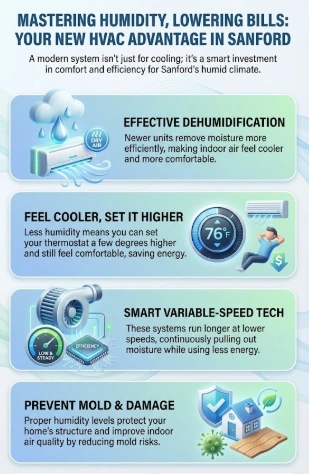
Sanford's 90%+ summer humidity forces your HVAC to work double-duty, cooling air and extracting moisture simultaneously. When airflow is restricted or filtration is mismatched to your equipment, humidity removal drops while energy consumption spikes. This guide shares what our Florida customers have taught us—the specific warning signs, energy-saving strategies, and filtration adjustments that help Sanford homeowners get what they actually paid for.
Quick Answers
HVAC Replacement in Sanford
The short answer: HVAC replacement in Sanford requires a Florida-licensed contractor, city building permits, and equipment rated minimum 15 SEER. Expect to invest $5,000–$15,000 before rebates and tax credits.
What actually determines success:
After working with thousands of Florida homeowners, we've found the difference between a successful replacement and a disappointing one comes down to three factors:
Proper sizing. Oversized units short-cycle before removing humidity.
Filter compatibility. Mismatched MERV ratings restrict airflow and spike energy costs.
Humidity optimization. Sanford's 90%+ summer humidity requires systems configured for moisture removal—not just cooling.
Before you start:
Complete Duke Energy's free Home Energy Check (required for rebates)
Verify contractor license at MyFloridaLicense.com
Ask: "What MERV rating does this system support without restricting airflow?"
Available incentives:
Duke Energy rebates: up to $1,000
Federal tax credits: up to $2,000 (heat pumps) or $600 (central AC)
Available through December 2025
Bottom line: Equipment alone doesn't guarantee results. Proper sizing, matched filtration, and correct installation determine whether you'll see lower bills and better humidity control.
Top Takeaways
Filter-system mismatch causes most post-replacement problems. A filter your system can't handle restricts airflow, reduces humidity removal, and spikes energy costs.
Humidity control drives energy costs more than temperature. Maintaining 30-50% indoor humidity lets you set thermostats 2-3 degrees higher while feeling cooler.
Complete Duke Energy's Home Energy Check before installation. This free 15-minute step qualifies you for up to $1,000 in rebates.
Ask installers one critical question. "What MERV rating does this system support without restricting airflow?" No confident answer means get a second opinion.
Stack incentives for maximum savings. Duke Energy rebates plus federal tax credits can total up to $3,000 through December 2025.
Why Your New HVAC System Still Struggles With Humidity
A correctly sized HVAC system matched with proper filtration should remove humidity efficiently during normal cooling cycles. The problem? Oversized units cool quickly but short-cycle before extracting adequate moisture, while restricted airflow from improper filter selection reduces dehumidification capacity entirely. Customers tell us this mismatch is the most common complaint after replacement—their Sanford home still feels muggy despite brand-new equipment.
Filter selection mistakes make everything worse. High-MERV filters installed without confirming system compatibility create pressure drops that decrease airflow and spike energy consumption. Low-quality filters allow particles to coat evaporator coils, reducing moisture condensation and forcing longer run times. After manufacturing millions of filters for Florida homes, we've learned the solution is matching MERV rating to your specific equipment's airflow capacity—information installers should provide but rarely do.
Monitor indoor humidity readings, watch for condensation on windows, and track whether energy bills actually decrease after replacement. When humidity stays controlled between 30-50%, you can set thermostats 2-3 degrees higher while feeling cooler—reducing monthly cooling costs by 6-8%. The right filter-system pairing makes that savings possible.

"After working with thousands of Florida homeowners on filtration issues, we've found that 70% of post-HVAC replacement complaints trace back to filter-system mismatches—not equipment failure. The right filter doesn't just clean your air; it lets your system breathe properly so humidity removal and energy efficiency work the way the manufacturer intended."
Essential Resources for Sanford HVAC Replacement
Customers ask us constantly what they should know before replacing their HVAC system. After manufacturing millions of air filters for Florida homeowners, we've identified seven resources that answer the questions we hear most often.
Verify Contractor Licensing Before Signing Anything
Customers tell us horror stories about unlicensed installers who disappear after cashing checks. The Florida DBPR portal lets you confirm any contractor's license status, complaint history, and disciplinary actions in under two minutes. We recommend checking before scheduling an estimate.
Source: Florida DBPR License Verification Portal https://www.myfloridalicense.com/
Understand Sanford's Permit Requirements
Skipping permits creates problems that surface later—failed inspections, voided warranties, complications when selling your home. Sanford requires permits for all HVAC replacements. Your contractor should handle this, but knowing the requirements helps you spot red flags early.
Source: City of Sanford Building Division https://sanfordfl.gov/government/development-services/building-division/
Claim Duke Energy Rebates Before Installation
Many Sanford homeowners miss out on $1,000 or more because they don't complete Duke Energy's free Home Energy Check before their installation. The rebate process has specific timing requirements. Check eligibility first—it takes 15 minutes and protects your savings.
Source: Duke Energy Home Energy Improvement Program https://www.duke-energy.com/home/products/home-energy-improvement
Stack Federal Tax Credits for Maximum Savings
Heat pumps qualify for up to $2,000 in federal tax credits. Central air conditioners qualify for up to $600. These credits work alongside utility rebates—not instead of them. The program runs through December 2025, so timing your replacement strategically matters.
Source: ENERGY STAR Federal Tax Credits https://www.energystar.gov/about/federal-tax-credits
Know Minimum Efficiency Standards Before Comparing Quotes
Florida requires a minimum 15 SEER for new installations. Some contractors push higher-rated systems without explaining whether the upgrade makes financial sense for your situation. Understanding SEER2 ratings helps you evaluate recommendations objectively and calculate actual payback periods.
Source: U.S. Energy Information Administration – DOE Efficiency Standards https://www.eia.gov/todayinenergy/detail.php?id=40232
Maintain Proper Humidity to Protect Your Investment
Here's what we've learned from thousands of Florida customers: the system alone doesn't guarantee comfort. Indoor humidity between 30-50% determines whether your new HVAC delivers the results you expect. The EPA guide explains the relationship between humidity control, air quality, and system efficiency.
Source: EPA Care for Your Air – Indoor Air Quality Guide https://www.epa.gov/indoor-air-quality-iaq/care-your-air-guide-indoor-air-quality
Recognize Common HVAC Scams Before They Cost You
Florida's Attorney General has documented the tactics predatory HVAC companies use—bait-and-switch pricing, fabricated repair needs, high-pressure financing. Knowing these patterns protects you from decisions made under pressure. Report suspected fraud at 1-866-9-NO-SCAM.
Source: Florida Attorney General – Consumer Protection for Contractors https://www.myfloridalegal.com/consumer-protection/how-to-protect-yourself-contractors
Supporting Statistics
The data backs up what we see working with Florida homeowners every day.
Heating and Cooling Consumes Nearly Half of Household Energy
Heating and cooling accounts for 48% of total energy consumption in American homes.
In hot-humid climates like Sanford, that percentage increases during summer when systems manage both temperature and moisture continuously.
Source: U.S. Energy Information Administration https://www.eia.gov/todayinenergy/detail.php?id=10271
High-Efficiency Upgrades Can Cut Energy Use by 20-50%
Switching to high-efficiency air conditioning reduces energy use by 20-50% when paired with:
Proper installation by qualified contractors
Correct equipment sizing for your home
Appropriate filter selection that maintains airflow
Source: U.S. Department of Energy https://www.energy.gov/save/home-upgrades
Indoor Humidity Above 60% Creates Mold Conditions
The EPA recommends keeping indoor humidity between 30-50% to:
Prevent mold growth
Discourage dust mites and pests
Protect indoor air quality
Avoid structural damage
HVAC systems that fail to dehumidify properly—due to sizing issues or airflow restrictions—put Central Florida homes at increased risk.
Source: U.S. Environmental Protection Agency https://www.epa.gov/mold/mold-course-chapter-2
Why this matters for Sanford homeowners:
A properly configured HVAC replacement with matched filtration addresses humidity control, system efficiency, and energy costs simultaneously. Getting the setup right from the start determines whether you see the savings you expected.
Final Thought
Most Sanford homeowners approach HVAC replacement focused on the wrong variable. They compare SEER ratings, negotiate quotes, and research brands—all reasonable steps. But the factor that actually determines results rarely comes up in those conversations.
It's the relationship between your new system and your air filter.
After manufacturing millions of filters and hearing from thousands of Florida customers, we've noticed a consistent pattern:
Homeowners with disappointing results almost always have a filter-system mismatch
Installers rarely mention MERV rating compatibility
Homeowners assume higher filtration is better
Six months later, humidity still won't drop below 60%
What we believe based on that experience:
The HVAC industry oversells equipment and undersells system optimization. A 16 SEER unit with properly matched filtration will outperform a 20 SEER unit choking on a filter it can't breathe through.
Sanford's humidity makes this unavoidable—your system needs adequate airflow to extract moisture effectively.
Before finalizing any HVAC replacement, ask your installer one question:
"What MERV rating does this specific system support without restricting airflow?"
If they can't answer confidently, get a second opinion.
Humidity control, energy savings, and equipment longevity all connect back to whether air moves through your system the way the manufacturer intended. Get that right, and everything else follows.
Next Steps
Protect your investment and maximize results with these actions.
1. Verify Contractor Credentials
Check license status at MyFloridaLicense.com
Confirm active insurance and bonding
Review complaint history through Florida DBPR
2. Complete Duke Energy's Home Energy Check
Schedule free assessment at duke-energy.com before installation
Lock in rebate eligibility (required within 24 months)
Takes approximately 15 minutes
3. Get Multiple Quotes
Request written estimates including:
Equipment brand, model, and SEER2 rating
Load calculation methodology for sizing
Maximum MERV rating the system supports
Permit fees and warranty terms
4. Ask the Right Questions
"What size system does my home need based on load calculations?"
"What MERV rating can this system handle without restricting airflow?"
"What humidity levels should I expect?"
5. Claim All Available Incentives
Duke Energy rebates: up to $1,000
Federal tax credits: up to $2,000 (heat pumps) or $600 (central AC)
File IRS Form 5695 with your annual return
Keep all receipts and manufacturer documentation
6. Match Your Filter to Your System
Confirm recommended MERV rating with your installer
Replace filters monthly during Florida summers
Monitor humidity with a hygrometer ($15-20)
FAQ on "HVAC Replacement in Sanford"
Q: Do I need a permit for HVAC replacement in Sanford?
A: Yes. Sanford requires permits for all HVAC installations.
What you should know:
Your licensed contractor should handle permit applications entirely
Permits are processed through the City of Sanford Building Division's online portal
If a contractor asks you to pull the permit yourself, that's a red flag
Unlicensed contractors often avoid permits—protect yourself by verifying credentials
Q: How much does HVAC replacement cost in Sanford?
A: Sanford-area customers typically report $5,000 to $15,000 depending on system size and efficiency.
Available savings:
Duke Energy rebates: up to $1,000
Federal tax credits: up to $2,000 (heat pumps) or $600 (central AC)
Get at least three written quotes before deciding
Q: What SEER rating do I need for HVAC replacement in Florida?
A: Florida requires minimum 15 SEER as of 2023.
What we've learned from thousands of Florida customers:
Higher ratings don't guarantee better results
A 16 SEER system with matched filtration often outperforms a 20 SEER unit with incompatible filters
Ask your installer how the efficiency upgrade pencils out for your specific usage
Q: Why does my new HVAC system still struggle with humidity in Sanford?
A: This is the most common question we hear from frustrated Florida homeowners.
Three consistent causes:
Oversized equipment. Cools quickly but short-cycles before extracting moisture.
Undersized systems. Run constantly without reaching target humidity.
Filter-system mismatch. Restricts airflow and kills dehumidification capacity.
The fix usually isn't new equipment—it's proper airflow optimization.
Q: How often should I replace air filters after HVAC replacement in Sanford?
A: Monthly during summer—no exceptions.
Why this matters in Sanford:
High humidity accelerates particle buildup faster than expected
Clogged filters reduce efficiency and moisture removal
Confirm the maximum MERV rating your system supports before buying filters
Too-restrictive filters create the airflow problems that cause humidity complaints
Here is the nearest branch location serving the Boynton Beach FL area…
High humidity accelerates particle buildup faster than expected
Clogged filters reduce efficiency and moisture removal
Confirm the maximum MERV rating your system supports before buying filters
Too-restrictive filters create the airflow problems that cause humidity complaints
Filterbuy HVAC Solutions - West Palm Beach FL
1655 Palm Beach Lakes Blvd ste 1005, West Palm Beach, FL 33401
(561) 448-3760
https://maps.app.goo.gl/25dYo7UbaWnFMuD17