Do MERV 13 17x22x4 Air Filters Restrict Airflow?
TL;DR
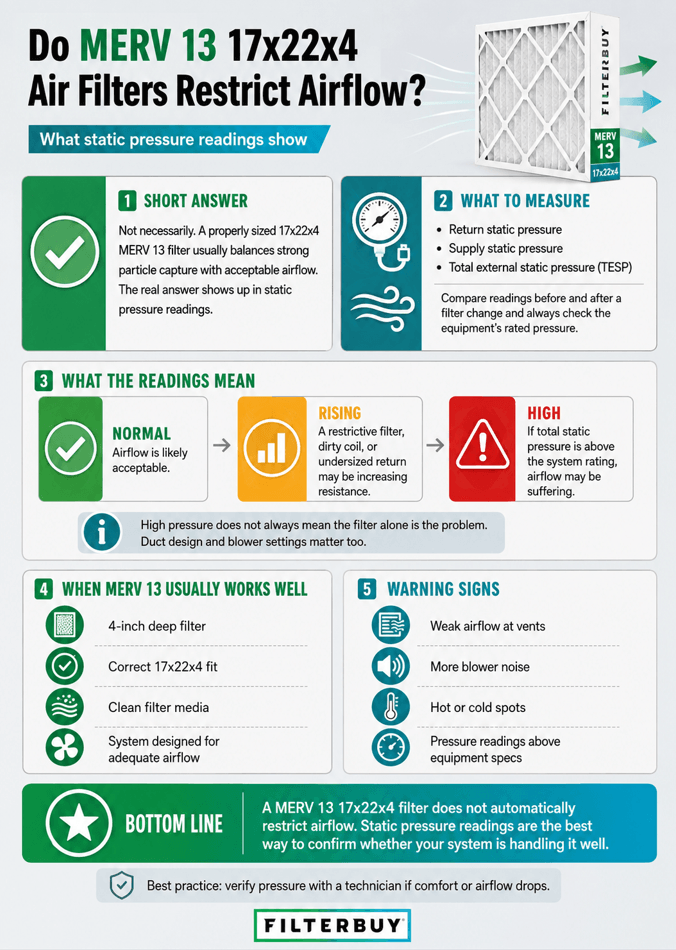
A MERV 13 17x22x4 filter is neither automatically restrictive nor automatically safe. Field research puts high-MERV pleated filters at 0.19 to 0.32 inches of water column, against the 0.10 in. w.c. duct design assumes. What matters is your blower rating and the air moving through 374 square inches of face. A manometer settles it in ten minutes.
The Short Answer
A MERV 13 17x22x4 adds two to three times the resistance of a low-MERV fiberglass panel, but four-inch depth spreads that load across more media. Below about 780 CFM, roughly two tons, it stays inside the 300 fpm face-velocity limit ACCA Manual D sets.
Key Takeaways
Duct design assumes 0.10 in. w.c. across the filter. Proctor measured an average of 0.28 in. w.c. in 34 California systems, nearly triple that.
A 17x22x4 has 374 square inches of face, 25% less than a 20x25x4. It reaches Manual D's 300 fpm ceiling at about 780 CFM.
Most equipment is rated for 0.50 in. w.c. TESP. The National Comfort Institute reports typical field systems run near 0.82 in. w.c. before a filter is considered.
Your blower type decides what a high reading costs. A PSC motor loses airflow; an ECM burns energy instead.
Replace on pressure, not the calendar. Record the clean reading and swap when it roughly doubles.
How Much Static Pressure Does a MERV 13 Filter Add?
Roughly 0.19 to 0.32 in. w.c. Stephens, Novoselac, and Siegel instrumented two systems in an Austin test house and logged 0.10 in. w.c. for low-MERV filters, 0.19 for MERV 8, and 0.32 for MERV 11, with airflow 7% and 11% lower on the high-MERV units. Those are one-inch panels, so they set the ceiling rather than the floor.
The Number Two Separate Studies Landed On
Two independent field studies converged on the same figure, and neither cites the other. Proctor measured 34 California homes and averaged 0.28 in. w.c. Lawrence Berkeley National Laboratory monitored ten other homes for a year each and averaged 71 Pa, or 0.285 in. w.c.
That agreement supports a specific claim: real-world filter pressure in a typical house runs about three times what the ducts were designed around. A MERV 13 is not introducing that problem. It is inheriting one.
Why Face Velocity Matters More Than MERV on a 17x22x4
Face velocity drives pressure drop, and this size runs hotter than most. A 17x22x4 offers 374 square inches of face against 500 for a 20x25x4, so 25% less area does the same work.
ACCA Manual D caps filter face velocity at 300 fpm, which a 17x22x4 reaches at about 780 CFM, roughly two tons. A three-ton system at 1,200 CFM runs near 462 fpm, close to the 492 fpm ASHRAE 52.2 uses for lab resistance data.
Actual size is smaller still, about 16.5 x 21.5 x 3.63 inches, pushing 1,200 CFM to roughly 487 fpm. At or below two tons, a MERV 13 sits inside the limit. Above that, measure.
Does Four-Inch Depth Actually Help?
Usually, but less than marketing suggests. LBNL found four-inch MERV 16 filters measurably less restrictive than one-inch versions, and Allison Bailes measured 0.06 in. w.c. across a four-inch MERV 13. But Davis Energy Group found a four-inch MERV 12 only marginally better than one-inch filters of similar rating. Depth helps; media quality decides how much.
How Do I Measure Pressure Drop Across My 17x22x4 Filter?
With a dual-port manometer and two test ports. ACCA puts a full kit under $200. Drilling risks hitting a coil, blower, or heat exchanger, so a technician can take the readings during a maintenance visit instead.
Drill two 3/8-inch test ports, one upstream of the filter and one immediately downstream.
Run the blower on high and let it stabilize for three minutes.
Zero the manometer before each reading, since they drift.
Subtract the absolute values. Both readings will be negative. The difference is your filter's pressure drop.
Measure TESP separately. Add the supply-side reading to the absolute value of the return-side reading and compare to the nameplate.
Reading the result:
0.10 in. w.c. or below: behaving as the duct design assumed.
0.10 to 0.25: raised. Check headroom under the nameplate figure.
Above 0.25 clean: this filter is eating half of a 0.50 in. w.c. budget.
TESP above nameplate: the ducts are the problem. A lower MERV masks it rather than fixing it.
Which replacement rule to use?
Two thresholds circulate, and they conflict. A flat 0.10 in. w.c. rule condemns a new filter on the average system, where a clean reading is already 0.29. ASHRAE 52.2 is better: a filter is spent when resistance doubles from clean. Write the clean reading on the frame and use that as your trigger.
What Does a High Reading Actually Cost You?
That depends on your blower motor, and most filter guides omit it. A PSC motor does not fight rising pressure: it moves less air, so the bill barely moves while cooling capacity quietly drops. Stephens cites research putting roughly 90% of residential systems on PSC blowers. An ECM instead ramps up to hold airflow, moving the cost onto the utility bill. LBNL measured about 20% higher blower energy on ECM homes pushed to MERV 16.
What If the Readings Are Too High?
Work cheapest first, since most high readings are not a MERV problem.
Replace the filter and re-measure. A loaded filter doubling its clean drop is expected.
Check the fit. A loose filter lets air bypass the media, lowering your reading and filtration together.
Check the return. An upstream reading above roughly 0.05 in. w.c. points to an undersized grille or duct.
Add filter area before dropping MERV. A larger cabinet or filter grille lowers face velocity, the real lever.
Only then step down to MERV 11 rather than MERV 8, which still captures smoke and smog.
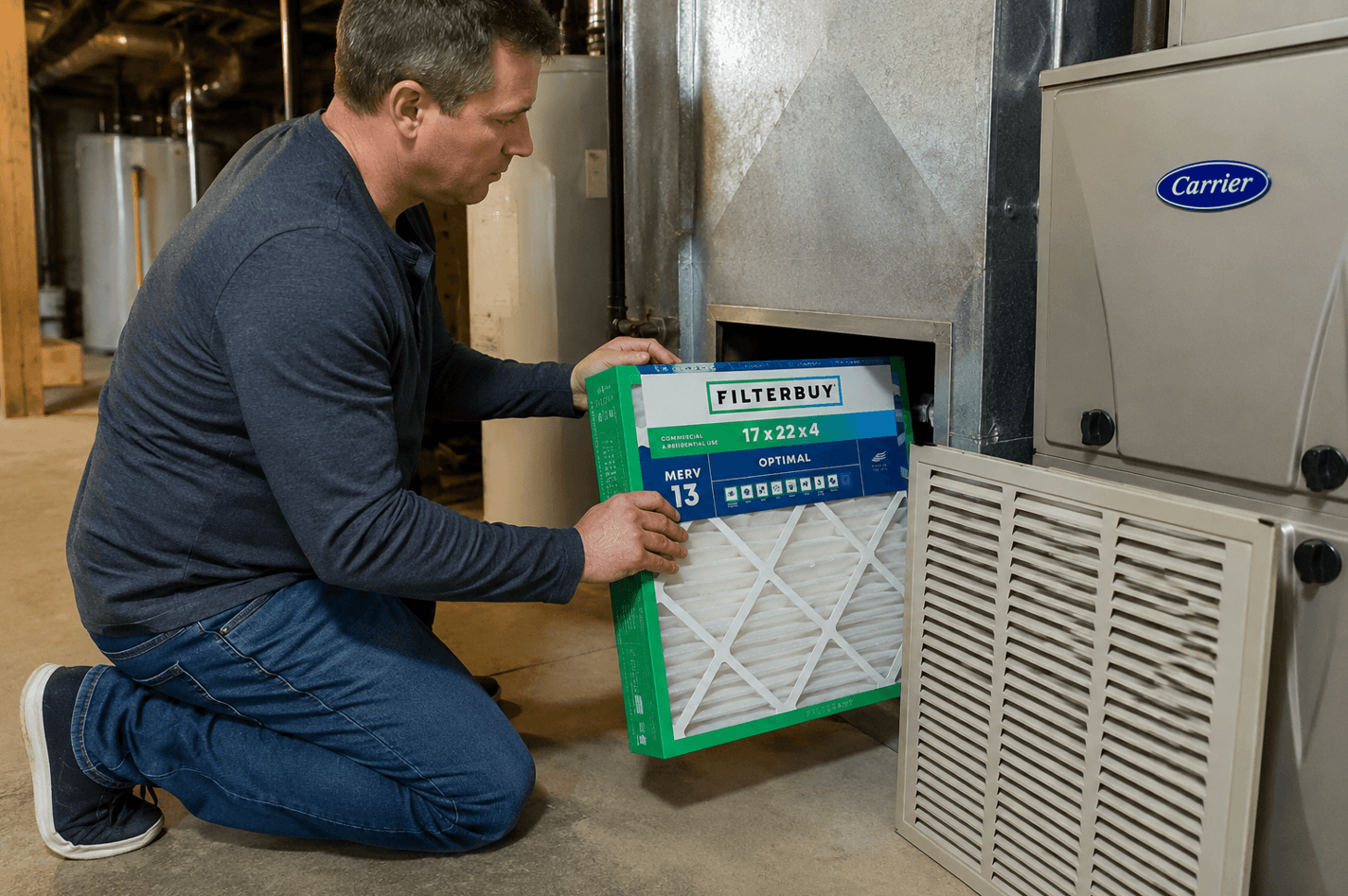
"We have cut open filters returned by customers certain their MERV 13 was choking the system, and most of the time the pleats were still clean. The real restriction was a return duct undersized since the day the house was built. Put a manometer on it before you drop your MERV rating.”
-The Filterbuy Team
Essential Resources on 17x22x4 Air Filters
1. Get the Exact Specifications Before Ordering
Nominal and actual dimensions differ, and an air filter that does not seat properly lets air bypass the media.
Source: Filterbuy: 17x22x4 Air Filters
2. Learn the Static Pressure Test Technicians Use
A step-by-step walkthrough of measuring TESP on a residential furnace.
Source: Air Conditioning Contractors of America
3. See What MERV 13 Captures and What It Costs
NIOSH compares MERV 13 against MERV 8 by particle size and states plainly that higher efficiency can raise pressure drop.
Source: CDC / NIOSH Ventilation FAQ
4. Match Filtration to Your Household's Health Needs
The American Lung Association recommends MERV 13 or above where a system supports it, and explains what that buys asthma and allergy sufferers.
Source: American Lung Association: Air Cleaning
5. Build a Maintenance Routine That Protects Airflow
A seasonal checklist covering what to inspect yourself and what to expect from a contractor.
Source: ENERGY STAR Maintenance Checklist
Supporting Statistics
1. ASHRAE Defines MERV 13 as at Least 85% Capture of 1 to 3 Micron Particles
ANSI/ASHRAE Standard 52.2 sets the MERV 13 threshold at 50% or better on 0.3 to 1.0 micron particles and 85% or better on 1.0 to 3.0 micron particles, which is the filtration you are buying with the pressure penalty. The same standard requires a filter's final resistance to be tested at no less than twice its initial resistance.
Source: ASHRAE: Standard 52.2-2017, Method of Testing General Ventilation Air-Cleaning Devices
2. Field-Measured Filter Pressure Averaged 71 Pa, About 0.29 In. W.C.
LBNL tracked ten homes for a year each and found loading varied more between houses than between MERV ratings, so any published replacement interval is a starting guess.
Source: Lawrence Berkeley National Laboratory: Energy Implications of In-Line Filtration
3. Air Conditioning Was Used in 88% of U.S. Households in 2020
Nearly all those central systems have a fixed filter face area that was never measured after installation.
Source: U.S. Energy Information Administration: Household Air Conditioning Use
Final Thoughts
The industry has trained homeowners to answer airflow complaints by buying a cheaper filter, and the field data says that is backwards. If a typical house already runs triple the design assumption before any upgrade, dropping to MERV 8 trades away real health benefit to avoid diagnosing a duct problem that will still be there next season. The filter is the one part a homeowner can change in five minutes, which is why it gets blamed for problems it did not cause. Keep the MERV 13 if your numbers allow it.
Next Steps
Confirm your size. Nominal 17x22x4 measures about 16.5 x 21.5 x 3.63 inches actual.
Check the nameplate for tonnage or rated CFM and the TESP limit, usually 0.50 in. w.c.
Take the readings yourself or via a technician. Record filter drop and TESP with the date.
Act on what you find. Loaded filter, replace it. High on a clean filter, check fit, then the return. TESP over nameplate, book a duct evaluation before changing MERV.
Write the clean reading on the frame and re-measure seasonally.
Frequently Asked Questions
Q: Do MERV 13 17x22x4 Air Filters Restrict Airflow?
A: They add resistance, but a 17x22x4 stays inside Manual D's 300 fpm limit up to about 780 CFM, roughly two tons.
Q: What Static Pressure Reading Is Too High?
A: 0.10 in. w.c. or below matches the design assumption. 0.10 to 0.25 is raised. Above 0.25 on a clean filter, that one component is eating half of a 0.50 in. w.c. budget.
Q: What Is the Actual Size of a 17x22x4 Air Filter?
A: About 16.5 x 21.5 x 3.63 inches. The undersize is intentional so it seats without binding, which puts real face area closer to 355 square inches than 374.
Q: Will a MERV 13 Filter Damage My Furnace?
A: Not directly. On a PSC motor, airflow drops; on an ECM motor, energy use climbs. Damage comes from sustained low airflow, and the data points at ductwork more often than the filter.
Q: How Often Should I Replace a 17x22x4 Filter?
A: When the reading roughly doubles from its clean baseline. Loading varies more by household than by MERV rating, so published intervals are starting points.
Measure First, Then Choose Your Filter
You now know what a MERV 13 17x22x4 costs in static pressure and how to find your own number. Take the reading this week, then order the MERV rating your measurements support.
Glossary
Static pressure: Force air exerts against duct walls, in inches of water column. Resistance, not airflow. TESP: Supply-side plus the absolute value of return-side static pressure. Most equipment is rated for 0.50 in. w.c. Face velocity: Airflow divided by filter face area, in feet per minute. Nominal vs. actual: The rounded label versus the measured size, which runs slightly smaller so the filter seats.
Learn more about HVAC Care from one of our HVAC solutions branches…
Filterbuy HVAC Solutions - Weston FL
2573 Mayfair Lane Weston FL 33327
(754) 296-3528
https://maps.app.goo.gl/E3tjmKf5VSWYghGc7